Saturday, January 18, 2014

The Onion

Every Saturday morning, I get a poetry newsletter from Tweetspeak Poetry.  It is one of the highlights of my week...to sit with a cup of coffee and see the poetry and poetry related links that they put in the newsletter.
This morning it was Pablo Neruda's poem- Ode to the Onion.


ODE TO THE ONION
by Pablo Neruda
Onion,
luminous flask,
your beauty formed
petal by petal,
crystal scales expanded you
and in the secrecy of the dark earth
your belly grew round with dew.
Under the earth
the miracle
happened
and when your clumsy
green stem appeared,
and your leaves were born
like swords
in the garden,
the earth heaped up her power
showing your naked transparency,
and as the remote sea
in lifting the breasts of Aphrodite
duplicating the magnolia,
so did the earth
make you,
onion
clear as a planet
and destined
to shine,
constant constellation,
round rose of water,
upon
the table
of the poor.

You make us cry without hurting us.
I have praised everything that exists,
but to me, onion, you are
more beautiful than a bird
of dazzling feathers,
heavenly globe, platinum goblet,
unmoving dance
of the snowy anemone
and the fragrance of the earth lives
in your crystalline nature.

Last summer I stole some onions from out community garden neighbor.  I thought they had abandoned their plot so I took two...maybe three.  Imagine my surprise when I saw the whole plot harvested a few days later.  It really was glorious to pull those onions out of the ground and I know that I'll be planting some this summer.  Maybe someone will steal some of mine and I will feel better.  Most of my patty pan squash was lifted so I guess all's well that ends well. Or something like that.
Anyway, the poem came with a  recipe for French onion soup.

So I made some in our wok.  I need to look for a cast iron skillet at the thrift stores.  
Here is the recipe from Tweetspeak.

  • French Onion Soup
  • An old recipe from the Roman era, this French Onion soup goes well with cold days and Pablo Neruda's "Ode to the Onion."
    Servings
    4

    Ingredients

    Instructions

    1. Bring a large cast iron pot to the stove and melt the butter and oil over medium heat. Add the onions and stir well to coat. Season with 2 teaspoons salt and a few turns of freshly cracked pepper. Cook for 15 to 20 minutes, or until the onions have softened and a few strands are just beginning to turn golden.
    2. Reduce the heat to medium low. Toss in the bay leaf, cover, and cook for 30 to 40 minutes more. I like to check my onions at 20 minutes, just to be sure they’re not sticking to the bottom of the pan. For the remaining 10 to 20 minutes, come back occasionally to give the pot a stir. If your onions still aren’t done, be patient and give them more time. They’re done when the onions have become an almost creamy mound in the bottom of your pot. They will be slightly golden, but don’t need to be dark brown.
    3. Before moving on, heat your oven to 450 degrees and set out soup bowls on a sturdy baking sheet. Add the balsamic vinegar, thyme, and vegetable stock. It’s important that you taste the soup now and adjust the seasonings until it tastes just right to you. Simmer for 10 minutes more.
    4. Ladle the soup into bowls and top with three slices of bread and a mound of cheese. Bake for 10 minutes, or until the cheese is melted and brown in spots.

    It took about 2 and a half hours to cook this and it was delicious.  I used smoked Gruyere to add to the taste and I used just regular thyme from a jar.


    I've had that ceramic serving bowl since before I was married.  My mother bought it for me at a pottery store in downtown Palo Alto.  It used to have a lid and matching bowls but they have gone the cracked way of pottery.  It's still my favorite serving bowl.

    We ate it with a lettuce, red onion, grape tomato, almond and goat cheese salad.


    I think that anything goes better with a little goat cheese.

    In Robert Farrar Capon's book The Supper of the Lamb:  A Reflection, he devotes a large section to cutting of onions and reflecting on it's beauty.  From the book.

    For somehow, beneath this gorgeous paradigm of unnecessary being, lies the Act by which it exists. You have just now reduced it to its parts, shivered it into echoes, and pressed it to a memory, but you have also caught the hint that a thing is more than the sum of all the insubstantialities that comprise it. Hopefully, you will never again argue that the solidities of the world are mere matters of accident, creatures of air and darkness, temporary and meaningless shapes out of nothing. Perhaps now you have seen at least dimly that the uniquenesses of creation are the result of continuous creative support, of effective regard by no mean lover. He likes onions, therefore they are. The fit, the colors, the smell, the tensions, the tastes, the textures, the likes, the shapes are a response, not to some forgotten decree that there may as well be onions as turnips, but to His present delight - His intimate and immediate joy in all you have seen, and in the thousand other wonders you do not even suspect. With Peter, the onion says, Lord, it is good for us to be here. Yes, says God. Tov, Very good.” 
    ― Robert Farrar CaponThe Supper of the Lamb: A Culinary Reflection


    Sunday, January 5, 2014

    Epiphany


    Epiphany by Janet Mackenzie of BridgeBuilding icons.

    The Journey Of The Magi

    'A cold coming we had of it,
    Just the worst time of the year
    For a journey, and such a long journey:
    The ways deep and the weather sharp,
    The very dead of winter.'
    And the camels galled, sorefooted, refractory,
    Lying down in the melting snow.
    There were times we regretted
    The summer palaces on slopes, the terraces,
    And the silken girls bringing sherbet.
    Then the camel men cursing and grumbling
    and running away, and wanting their liquor and women,
    And the night-fires going out, and the lack of shelters,
    And the cities hostile and the towns unfriendly
    And the villages dirty and charging high prices:
    A hard time we had of it.
    At the end we preferred to travel all night,
    Sleeping in snatches,
    With the voices singing in our ears, saying
    That this was all folly.

    Then at dawn we came down to a temperate valley,
    Wet, below the snow line, smelling of vegetation;
    With a running stream and a water-mill beating the darkness,
    And three trees on the low sky,
    And an old white horse galloped away in the meadow.
    Then we came to a tavern with vine-leaves over the lintel,
    Six hands at an open door dicing for pieces of silver,
    And feet kiking the empty wine-skins.
    But there was no information, and so we continued
    And arriving at evening, not a moment too soon
    Finding the place; it was (you might say) satisfactory.

    All this was a long time ago, I remember,
    And I would do it again, but set down
    This set down
    This: were we led all that way for
    Birth or Death? There was a Birth, certainly
    We had evidence and no doubt. I had seen birth and death,
    But had thought they were different; this Birth was
    Hard and bitter agony for us, like Death, our death.
    We returned to our places, these Kingdoms,
    But no longer at ease here, in the old dispensation,
    With an alien people clutching their gods.
    I should be glad of another death.

    T.S. Eliot

    And for a completely different perspective!


    The Queens Came Late


    The Queens came late, but the Queens were there
    With gifts in their hands and crowns in their hair.
    They'd come, these three, like the Kings, from far,
    Following, yes, that guiding star.
    They'd left their ladles, linens, looms,
    Their children playing in nursery rooms,
    And told their sitters:
    "Take charge! For this
    Is a marvelous sight we must not miss!"
    The Queens came late, but not too late
    To see the animals small and great,
    Feathered and furred, domestic and wild,
    Gathered to gaze at a mother and child.
    And rather than frankincense and myrrh
    And gold for the babe, they brought for her
    Who held him, a homespun gown of blue,
    And chicken soup--with noodles, too-
    And a lingering, lasting, cradle-song.
    The Queens came late and stayed not long,
    For their thoughts already were straining far-
    Past manger and mother and guiding star
    And a child aglow as a morning sun-
    Toward home and children and chores undone.

    -Norma Farber in When It Snowed That Night

    Wednesday, January 1, 2014

    A Happy, Holy and Hopeful New Year.

    We spent our last few days of 2013 at the Oregon Coast.   First one day with Elisabeth before I took her back to Seattle Pacific.


    Family Selfie.


    Then Paul and I rented a yurt and went camping for a night


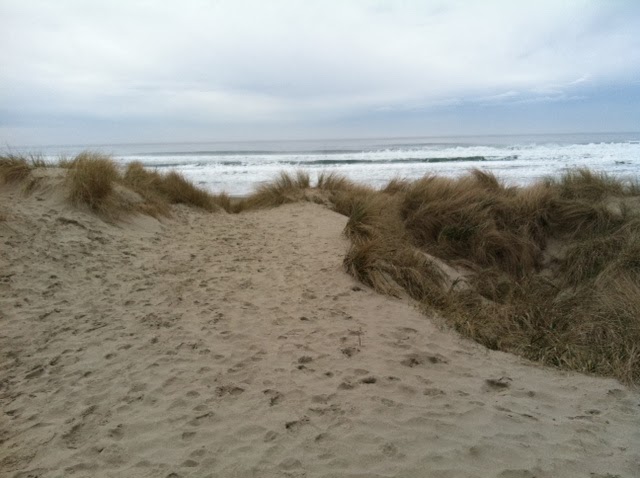
    We read, we played scrabble, we ate hobo stew in foil packets and we walked on the beach.
    .


    It was a lovely and restful time.

    While we were there, I read Telling Secrets by Frederich Buechner.  I grabbed this book off the shelf in Powell's Books last week as I have been wanting to read some of Buechner's books.  I've seen many quotes of his writing and I knew I needed to read him.  I  can not recommend this book highly enough and I will be looking for more of his writing.  His life is very deep and he has important things to say.  Here is the central them of the book.

    “I have come to believe that by and large the human family all has the same secrets, which are both very telling and very important to tell. They are telling in the sense that they tell what is perhaps the central paradox of our condition—that what we hunger for perhaps more than anything else is to be known in our full humanness, and yet that is often just what we also fear more than anything else. It is important to tell at least from time to time the secret of who we truly and fully are—even if we tell it only to ourselves—because otherwise we run the risk of losing track of who we truly and fully are and little by little come to accept instead the highly edited version which we put forth in hope that the world will find it more acceptable than the real thing. It is important to tell our secrets too because it makes it easier that way to see where we have been in our lives and where we are going. It also makes it easier for other people to tell us a secret or two of their own, and exchanges like that have a lot to do with what being a family is all about and what being human is all about.” 
    ― Frederick BuechnerTelling Secrets

    I've come across this other quote by him twice in the last 24 hours and I try to pay attention when that happens.

    There is no event so commonplace but that God is present within it, always hiddenly, always leaving you room to recognize him or not to recognize him…Listen to your life. See it for the fathomless mystery it is. In the boredom and pain of it, no less than in the excitement and gladness: touch, taste, smell your way to the holy and hidden heart of it, because in the last analysis all moments are key moments, and life itself is grace."
    – Frederick Buechner, Listening to Your Life


    I started off the New Year by listening to Wendell Berry read his poem about hope.  

    The text is below.  It's well worth the time to hear him read.


    It is hard to have hope. It is harder as you grow old,
    For hope must not depend on feeling good
    And there is the dream of loneliness at absolute midnight.
    You also have withdrawn belief in the present reality
    Of the future, which surely will surprise us,
    …And hope is harder when it cannot come by prediction
    Any more than by wishing. But stop dithering.
    The young ask the old to hope. What will you tell them?
    Tell them at least what you say to yourself.
    Because we have not made our lives to fit
    Our places, the forests are ruined, the fields eroded,
    The streams polluted, the mountains overturned. Hope
    Then to belong to your place by your own knowledge
    Of what it is that no other place is, and by
    Your caring for it as you care for no other place, this
    Place that you belong to though it is not yours,
    For it was from the beginning and will be to the end
    Belong to your place by knowledge of the others who are
    Your neighbors in it: the old man, sick and poor,
    Who comes like a heron to fish in the creek,
    And the fish in the creek, and the heron who manlike
    Fishes for the fish in the creek, and the birds who sing
    In the trees in the silence of the fisherman
    And the heron, and the trees that keep the land
    They stand upon as we too must keep it, or die.
    This knowledge cannot be taken from you by power
    Or by wealth. It will stop your ears to the powerful
    when they ask for your faith, and to the wealthy
    when they ask for your land and your work.
    Answer with knowledge of the others who are here
    And how to be here with them. By this knowledge
    Make the sense you need to make. By it stand
    In the dignity of good sense, whatever may follow.
    Speak to your fellow humans as your place
    Has taught you to speak, as it has spoken to you.
    Speak its dialect as your old compatriots spoke it
    Before they had heard a radio. Speak
    Publicly what cannot be taught or learned in public.
    Listen privately, silently to the voices that rise up
    From the pages of books and from your own heart.
    Be still and listen to the voices that belong
    To the streambanks and the trees and the open fields.
    There are songs and sayings that belong to this place,
    By which it speaks for itself and no other.
    Found your hope, then, on the ground under your feet.
    Your hope of Heaven, let it rest on the ground
    Underfoot. Be it lighted by the light that falls
    Freely upon it after the darkness of the nights
    And the darkness of our ignorance and madness.
    Let it be lighted also by the light that is within you,
    Which is the light of imagination. By it you see
    The likeness of people in other places to yourself
    In your place. It lights invariably the need for care
    Toward other people, other creatures, in other places
    As you would ask them for care toward your place and you.
    No place at last is better than the world. The world
    Is no better than its places. Its places at last
    Are no better than their people while their people
    Continue in them. When the people make
    Dark the light within them, the world darkens.
    -Wendell Berry


    Friday, December 27, 2013

    The Light has come.

    Turn around and believe that the good news that we are loved is better than we ever dared hope, and that to believe in that good news, to live out of it and toward it, to be in love with that good news, is of all glad things in this world the gladdest thing of all. Amen, and come Lord Jesus.
    -Frederick Buechner

    The winter solstice has come and so has Christmas.  God speaks in creation as the days get longer.   Winter is usually a productive time for me.  I have great energy for knitting and reading and planning.  Sometimes I think that I love Advent more than Christmas- that sense of anticipation and planning.
    I've been thinking a lot about light and found this on the blog This Sacramental Life  Check out the pictures and the video at the bottom- they are exquisite.
    Light Shower    


    This poem came to me through the Tumbler Blog LitVerve.  I love Christian Wiman's thought and poetry and these images of light and dark moved me.


    Hard Night
    What words or harder gift
    does the light require of me
    carving from the dark
    this difficult tree?

    What place or farther peace
    do I almost see
    emerging from the night
    and heart of me?

    The sky whitens, goes on and on.
    Fields wrinkle into rows
    of cotton, go on and on.
    Night like a fling of crows
    disperses and is gone.

    What song, what home,
    what calm or one clarity
    can I not quite come to,
    never quite see:
    this field, this sky, this tree.


    "

    – Christian Wiman, “Hard Night”


    More on Christian Wiman?   Check out this link.  Christian Wiman


    I also loved this poem as books are my friends and calm me into thought and silence.


    ZWIJGEN
    I slept before a wall of books and they
    calmed everything in the room, even
    their contents, even me, woken
    by the cold and thrill, and still
    they said, like the Dutch verb for falling
    silent that English has no accommodation for
    in the attics and rafters of its intimacies.
     - Saskia Hamilton


    Thursday, December 19, 2013

    Advent Musings.


    Love this banner by Amarilys Henderson. Other work can be purchased at Watercolor Devo


    Also this by Joanna Winter.  Can be purchased at Messy Lab studio

    I saw this picture on this fantastic blog This Sacramental Life


    Annunciation by John Collier
     from this source

    It gave me a new understanding of Mary.

    I read this poem by Malcolm Guite


      O Sapientia
    I cannot think unless I have been thought,
    Nor can I speak unless I have been spoken.
    I cannot teach except as I am taught,
    Or break the bread except as I am broken.
    O Mind behind the mind through which I seek,
    O Light within the light by which I see,
    O Word beneath the words with which I speak,
    O founding, unfound Wisdom, finding me,
    O sounding Song whose depth is sounding me,
    O Memory of time, reminding me,
    My Ground of Being, always grounding me,
    My Maker’s Bounding Line, defining me,
    Come, hidden Wisdom, come with all you bring,
    Come to me now, disguised as everything.

    Google Malcolm Guite - you'll be glad you did.  Priest, poet and rock and roll player.

    On less ethereal matters, Elisabeth is home for Christmas and we are glad. She has a new job in Seattle taking pizza orders at Zeke's. The Philippines is still very much on her heart and mind. Three young men from Alabama stayed the night last night while on their layover to the Philippines. She met them in Manila last summer. I do love a little bit of "Ma'am" every once and a while.
    I'll be changing jobs (again) in the New Year.  My adjunct job at George Fox is over for now- no classes for me to teach in the Spring.  I'll be working as a para-educator with ESL students in an elementary school that is 30% ESL students ( called ELL's at the elementary level).  I've sat through a few trainings and met the women I will work with and I think it will be a good fit for me.  I'll be working with 4th and 5th graders.
    Our foster son was officially adopted and is now with his forever family in the US.  This brings me such great peace.  He seems to be doing well and we are thankful for that.

    Christmas should be nice and quiet.  We will try to head over to the coast the day before or the day after Christmas.  We will open gifts and have a traditional Christmas brunch with the three of us and then head to the movies in the afternoon.

    Merry Christmas to all.


    Tuesday, December 10, 2013

    Watching and Waiting- A Few Random Thoughts.

    I've seen this video on several sites and it's definitely worth watching.


    Xu Bing and the Phoenix.
    The reality of the lives of migrants workers in China is grim.  For this man to see, truly see them is amazing.  We had many migrant workers in our city in China and their living conditions were terrible. 
      
    John Blase at the Beautiful Due The Beautiful Due  and Winn Collier at http://winncollier.com/ are doing parallel posts on Advent.  Really beautiful.

    I saw a post on Pinterest for black bean fudge- sugar free, gluten free and dairy free.  That isn't hard to say no to at all.  Yuck.  What's the point?

    The other day I got an e-mail from a student that said he couldn't come to class because he was "suck and tried."  Aren't we all?

    Another student apologized for not coming to class by saying "I am sorry for you."  It's so rare that someone is sorry for me that I accepted the apology.

    We actually had some snow here.  Not much but enough to make the roads slippery.  I couldn't get on the highway to get to work, because there was an accident that completely blocked the way.  So I had a Snow Day.  What is it about an unexpected day off that makes it feel like a week off?  It was lovely.

    I am reading Return to Our Senses:  Re-imagining How We Pray by Christine Sine.  It's a lovely book that is causing me to go deeper into prayer in so many ways. It's a mix between traditional and contemplative practices and it's so beautifully written.  It's available on Amazon and also the Mustard Seed  Associates website.  


    Saturday, December 7, 2013

    Advent


    Adeste

    Come all ye fickle, weary and worn.
    O come let us adore him like the O damn fools
    we are hanging on if by a thread to the tale
    of a girl and the god and the baby they sang
    into the whole dear world.
    ~
    O come all ye citizens of this turning scorn.
    O come let us sing though our eyes are tired
    of looking for his salvation. Let us raise our
    voices of that happy morn and groan him
    into the world one more time.
    John Blase posted at The Beautiful Due.


    In this season of hoping and waiting, I light the Advent candles each morning.


    One each week as we get closer and closer to the incarnation.  At a recent Advent retreat, lead by Christine Sine, we talked about the three comings of Jesus.  The first is in the flesh as a baby-this coming attracts our hearts but doesn't demand much of our soul.  The second is the coming presence of God in the resurrection-the question is how are we aware of the presence of God and what part do we want.  The third is the longing for the kingdom of God in the Second Coming- what are we longing for and how do our priorities of time, talent, and resources reflect that.
    Our lives are to be a balance and we set priorities of 

    Feasting and fasting

    Work and rest

    Solitude and Community

    So our bare tree


    becomes this tree


    as we celebrate the coming of Jesus.

    During this half day retreat, we also talked about Practices of Restoration and Practices of Transformation.  Our practices of restoration remind us of who we are in our faith community and identity- going to church or Mass, prayer, communion, Scripture reading.  At Christmas, the symbols of the tree, the Advent wreath, Nativity sets all remind us of of who we are.  Most practices of Restoration are highly structured and provide a certain measure of order and predictability. 
    Practices of transformation are more risky.  They are meant to transform us at our core and to give us a sense of God's eternal kingdom.  These practices have a high degree of creativity and unpredictability.  We have to choose them for ourselves....how do we really want to be transformed?  The practice may be a practice of silence, going deeper to hear the voice of God.  It may be working on a project or with a person who is unfamiliar or uncomfortable.  Whatever it is, it is designed to change us, to make us new and different.

    Recently a little sparrow came and looked inside our glass sliding door.


    It had snowed the day before and was very, very cold.  I put sunflowers on the patio and he hopped up and looked inside for quite a while.  Yet bringing him inside would mean certain stress and maybe even death.  Birds are designed to be outside in the cold-they fluff up their feathers and sit close together.  What seemed like a safe place for him to be (inside and warm) was the most dangerous for his life.  
    That is what a practice of transformation does for us- it puts us where we are meant to be.

    Our little foster son is with his family now.  There is such a sense of peace, knowing that he is safe and whole and loved.  We have been in this waiting season for so long now.  What a joy that his journey to his family is finished...and also just beginning.